 I rose (actually I was up most of the night) but I did not shine. But I'm always glad to see breakfast. Warm "coffee" and bread and cheeses and olives and veggies. I was in a much better mood after I ate. Exhausted and near the end of my capacity for hand-eye coordination, but in a much better mood.
 So this guy I spied from the train before we disembarked. He was just sitting there stuffing that bottle with strips of newspaper. Hey, why not? He must be one of those fidgety types who relaxes by doing, you know?
 Here we are on the platform, about to trek off to board the bus. We all lug our own baggage so packing lightly is a priority. Sally is the Queen at this. She managed to get all her stuff into her backpack (see her on the far right). I did all right too. My bag can also be worn on the back and is not as big as the one worn by the lady in the pink coat. Actually, I never even unzipped my expandable sections.
 Heading out to the bus.
 Ankara Railway Station looking oddly communistic.
 Kitty! We love them.
We are in Ankara today to see the Ankara Museum of Anatolian Civilizations and Atatürk's Mausoleum. First, the museum. We enjoyed the peaceful courtyard while we waited for the doors to open. .
Go to the web site 360 degree virtual tours of the place and flip through the artifact catalog (a highly condensed version). I have to say that I really dig flipping through the catalog of selected items. But a caption, even in Turkish (cuz you could plug it into a free online translator to at least get an idea), would have been helpful. As it is, I'm just looking at interesting pieces with no historical or cultural context.
 I was very excited to visit this museum. I took dozens of photos. I love a museum that allows photography.
Turkey is old, OK? I mean, people have been living in this part of the world for a very long time. Thirty thousand years? No. But about ten thousand. People with settled communities and even with writing. Before the trip, I was reading about the site at Çatalhöyük, Turkey (Çatal=fork, Höyük=mound). Hey, Rick Steves, I vote for skipping the carpet demonstration and instead taking the group to the Çatalhöyük site.
 Çatalhöyük is one of the first urban centers of the world, dating from 7,400 BCE during the Neolithic Age. The official web site of the dig had me pointing and clicking until my eyes dried up. I highly recommend you visit to learn more about the largest and best preserved Neolithic site ever discovered. Another great site is the Berkeley Archaeologists at Çatalhöyük site, Remixing Çatalhöyük.
 The inhabitants of Çatalhöyük buried their dead underground.
 One of a couple hundred "goddess" figurines unearthed at Çatalhöyük. Originally, it was thought that Çatalhöyük was a matriarchal society. Since the renewed interest in this site, starting in the '90's, it is now believed (though probably will be debated forever) that Çatalhöyük was neither matriarchal nor patriarchal, rather it was a pretty balanced situation.
Keep in mind that only some of the pieces in this museum are from Çatalhöyük. Çatalhöyük is a good starting point because it's the oldest. The museum covers thousands of years of Anatolian civilization.
I've included the entire description of this sun disk below it. Click any image to enlarge. .


 It's easy to be impressed simply by the age of the items in this museum. Some of them are 9,000 years old and some one made it by and and now I get to see it and imagine how it was handled and used. Was it appreciated and useful or was it always in someone's way and getting tossed in the corner?
It's also easy to be impressed with the craftsmanship of some of the items. Artists were at work. Sure, people needed water pitchers but stylized gold ones? And the beads on the necklace are so tiny. It's hard to tell from the photo but I was amazed by how delicate the beads appear.
Remember, click on any photo to enlarge.
 Here is another example of detail work that always catches my eye. Clay tablets covered in cuniform writing. This piece is about as big as an iPhone on steroids.
 This piece is slightly smaller and still partially surrounded by the clay "envelope" which enclosed it.
 Twin figurines are not uncommon. I failed to snap a shot of the identification card if there was one. But often the card simply listed the object and gave no further explanation.
  The piece below was found at the site of Acemhöyük, which dates to the 3rd millenium BCE. This piece is particularly impressive because it is carved from a single piece of ivory. Before I was back home and working on the photos, I assumed the visual noise at the base of this piece was caused by wear and age. Then I zoomed in and found the animals. After the third photo I've included the identification card from the museum.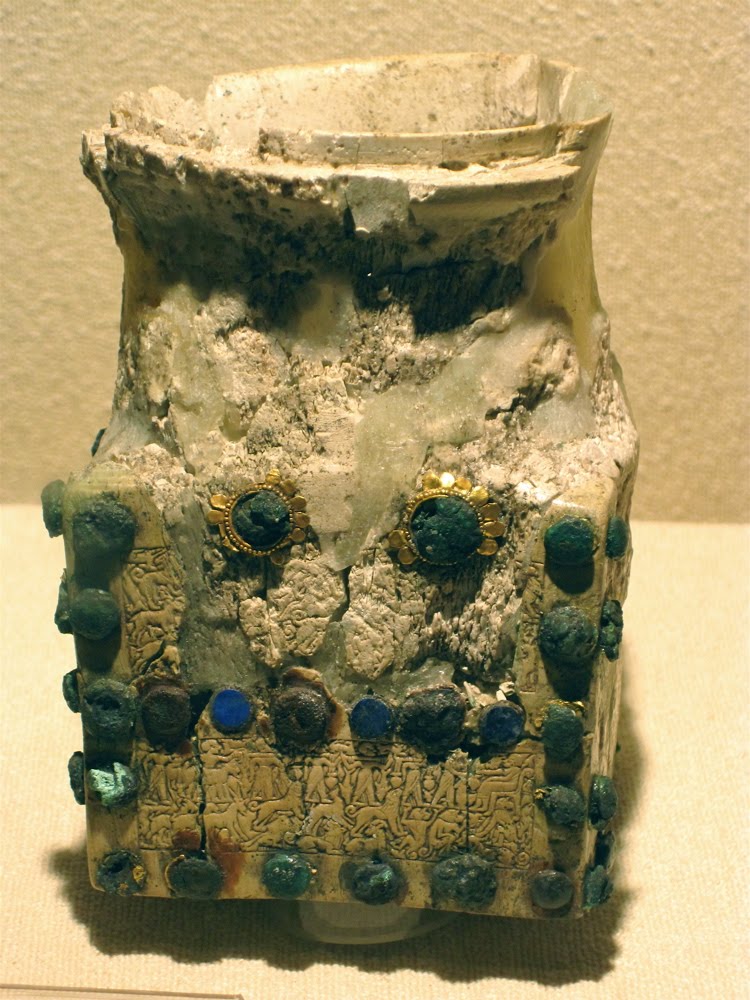


 Here is another great piece of detail work but this one is big. This is the only bronze tablet found in Anatolia. It's a treaty. I've posted the museum card.

 Now we're into the Hittite and Neo-Hittite Empires. Lots of big stone relief pieces and plenty of stone statues.
  This is a statue of King Tarhunza, 8th century BCE.
 A view of part of Ankara from the museum steps.
  Atatürk's Mausoleum. Mustafa Kemal Atatürk was the founder of the Republic of Turkey and its first president. He is Turkey's biggest hero, statesman, social transformer. He reinvented Turkey. He took the Ottoman Turkey and transformed it into the democratic, secular, nation-state it is today. To say he is revered is an understatement. At least what I could see and hear in my limited time in Turkey was all positive. His face is on all the money, in the schools, every other thing is named after him and his statues are everywhere.
  Places like this leave me cold. Statesmen and politicians do little to inspire me regardless of my global location. It's not that the information fell on deaf ears, but it was so much information. I could not possibly absorb it all or appreciate it all. It would be like asking someone from Turkey to come and spend a couple of hours touring a J.F.K. museum and hearing his speeches and looking at his tuxedos, and reading about his life over and over again. The detail on one of the buildings, however, caught my eye.
  I have to admit, the changing of the guard was impressive. Slow and deliberate. All of the Turkish armed forces are represented here. The position of guarding Atatürk's Mausoleum is highly regarded. They don't take just any schlub. We had the opportunity to tour the military museum and see inside the mausoleum. We did not tour the actual mausoleum. Check out the changing of the guard in these two video clips. A representative from wach of the Turkish services is in this procession.
 History makes me hungry! Our first pide. Pide (PEE-day), not to be confused with pita, comes in many manifestations. It could refer to the bread, it could refer to the finished product. Either way, it's delicious.
The dough is a basic dough and the toppings vary. The round version of the bread is not topped at all, just decorated with a cross-hatch of indentations. This boat shape is a popular style for topping. A common topping combination is cheese, spinach, and mushroom, like you see in this photo.
Toppings are not heavy, just a moderate amount. The bread is light. The crust is on the thin side but would not at all be considered thin crust.
Back on the road. We traveled for a while. This was kind of a heavy bus day but I really enjoyed watching the country go by. We couldn't see much on the train ride so this was our first real view of the land. I have to say that the Turkish country we explored varied a great deal in appearance. Much of what we saw looked like Eastern Washington. It was golden, relatively flat but with soft undulations, and grew wheat. Like in this photo below. I didn't mind at all looking at this for long periods of time.
 Some of Turkey looks like the American Southwest - a bit of scrub, some red rock, pines, crazy rock formations. You will see some of that in later posts.
Some was just highway. But we had nice rest stops everywhere. All were modern with plenty to offer, like the one shown below.

Though I never got around to buying one for myself, I did get a small taste of the very popular Magnum ice cream bar. Our group was just crazy about these things. They come in a variety of flavors and they were very tempting. Not sure why I never got around to having one. Granted, ice cream is never my first temptation or my second or third. Still, I should have tried one just cuz.

 We arrive at Old Greek House in the village of Müstafapaşa, our home for the next two nights. Our hosts were Süleyman (on the right) and Fuat (on the left) Öztürk. By the time we settle in, have dinner, have our informal get to know you session, and get to bed, there wasn't nearly as much time left for sleeping as I had hoped. The van would pick us up the next morning at 5:35 am for the hot air balloon ride.
 I think I mentioned earlier that there is a lot of cobblestone in Turkey. There are also a lot of un-level situations. Always watch your step. The stone stairs in this place were not level and no longer at 90 degree angles. Once at the top of the landing, watch your step as you enter the hallway with that red and black carpet - cuz you step up. If you need to use the common potty to the left, watch your step as you go in - cuz you step down. All of our rooms had private baths but we stil had to watch our step and our heads.
 I really wished we had eaten dinner in this room upstairs. But I understand what a pain in the rear it would have been for the staff.
 A nice view of the dining room. The room is, technically, open to the outside. Above a section of those grape vines is just air. Those stairs in the background lead directly up and out to the second floor terrace, which is covered but not enclosed. I never did find out what they do about dinner when it rains.
 Some of the group do some shopping, or at least some looking, before dinner.
 Yes, real grapes.
Return to Main Page or go straight to Day 5 - Cappadocia Part 1.


